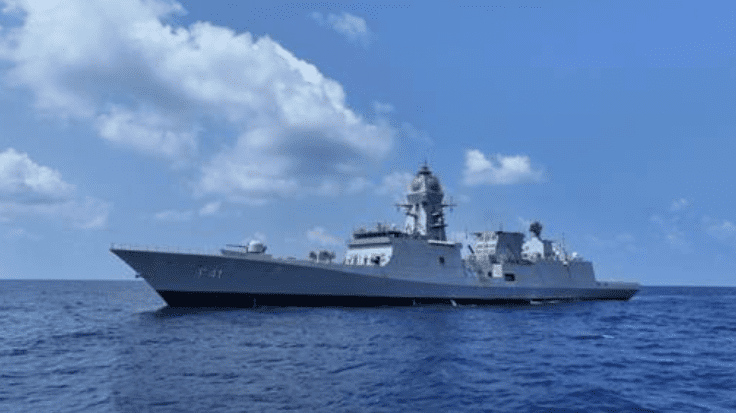
On April 3, 2026, the Indian Navy reached a major goal in maritime self-reliance. Specifically, the Navy formally commissioned INS Taragiri at the Naval Dockyard in Visakhapatnam. Raksha Mantri Rajnath Singh presided over the ceremony. Furthermore, Chief of Defence Staff General Anil Chauhan and the Chief of Naval Staff joined him. This induction marks the fourth vessel of the Project 17A Nilgiri class stealth frigates. The Taragiri represents a generational shift toward high-end naval warfare in a contested Indo-Pacific.
Technical Design: Building Lethal Stealth
The Taragiri is a masterclass in modular warship construction: Specifically, it displaces approximately 6,670 tonnes. The Warship Design Bureau designed the vessel. Meanwhile, Mazagon Dock Shipbuilders Limited built the ship in Mumbai. The design utilizes advanced hull shaping and radar-absorbent materials. Consequently, these features achieve a significantly minimized Radar Cross-Section. This lethal stealth also includes a sleeker form factor. This shape reduces both acoustic and infrared signatures. Therefore, it makes the ship a ghost in high-threat environments.
Power and Speed: The Propulsion System
The propulsion system is a sophisticated Combined Diesel or Gas plant. This configuration pairs high-efficiency diesel engines with high-output gas turbines. Specifically, the diesels handle long-endurance cruising. In contrast, the gas turbines provide rapid sprint speeds. A state-of-the-art Integrated Platform Management System manages these engines. Because each shaft has Controllable Pitch Propellers, the Taragiri offers great versatility. This is essential for sustained carrier escort duties. It is also vital for independent blue-water patrols.
Weaponry and Sensors: The MF-STAR Advantage
The combat power of the Taragiri centers on its Integrated Combat Management System, this system fuses data from many different sensors. The centerpiece is the EL/M-2248 MF-STAR radar. This is a four-faced Active Electronically Scanned Array system. Specifically, it can track hundreds of targets at the same time. These targets range from sea-skimming missiles to high-altitude threats.
For strike capability, the frigate features an 8-cell Vertical Launch System(VLS), this fires the BrahMos supersonic cruise missile. Therefore, it provides a 450-kilometer range for land-attack missions. For air defense, the ship utilizes Barak-8 missiles. These ensure a 70-kilometer defensive umbrella against saturation attacks. Additionally, the vessel has an advanced indigenous sonar suite. Dedicated torpedo launchers and rocket systems make it a premier hunter in the Indian Ocean.
Strategic Role: The Indo-Pacific Pivot
The commissioning of INS Taragiri is a direct response to rising geopolitical friction. Specifically, it addresses tensions in the Strait of Hormuz and the broader Indo-Pacific. As a multi-role platform, its use cases are diverse. First, it can act as a Carrier Strike Group escort. This provides a layered shield for aircraft carriers. Second, it functions as a security provider by leading anti-piracy operations.
Finally, its flexible profile allows for quick transitions to humanitarian missions. The Taragiri has over 75 percent indigenous content. Moreover, it involves over 200 small businesses in its supply chain. This is a clear signal of India’s growth as a builder of high-end surface combatants.
About the Author