For decades, the Indian Navy’s surface fleet has been defined by a philosophy of “lean and lethal.” From the Delhi-class to the contemporary Visakhapatnam-class (Project 15B), Indian destroyers have prioritized high-speed supersonic strike capabilities and sophisticated sensor suites over raw magazine depth. However, as the Indo-Pacific transforms into a contested theater dominated by saturation attacks and anti-access/area-denial (A2/AD) strategies, the “underarmed” commentary directed at Indian warships has reached a crescendo.
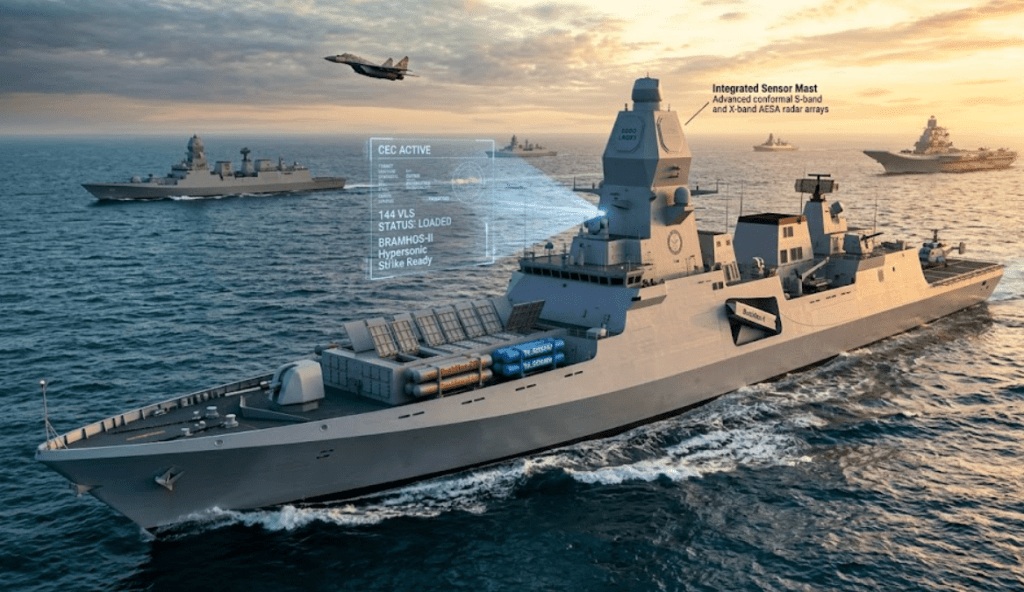
The response to this critique is the Next Generation Destroyer (NGD), or Project 18 (P-18). As of 2026, this program has transitioned from the drawing boards of the Warship Design Bureau to a national strategic priority. Displacing nearly 13,000 tonnes, the P-18 is not merely a destroyer; it is a cruiser-class behemoth designed to serve as the backbone of India’s blue-water aspirations.
Design Evolution: From Stealth to Supremacy
While the Kolkata and Visakhapatnam classes were incremental evolutions of the P-15 hull, Project 18 represents a clean-slate design. The most striking departure is the sheer scale. Moving from the 8,000-tonne P-15B to a 13,000-tonne platform allows for several critical advancements:
- Integrated Electric Propulsion (IEP): The NGD is expected to move away from traditional gas turbine arrangements in favor of IEP. This provides the massive electrical overhead required for next-generation systems, such as Directed Energy Weapons (DEW) and advanced AESA radars, while simultaneously reducing the ship’s acoustic signature.
- Integrated Mast and Sensor Fusion: Borrowing design cues from the Japanese Mogami-class or the UNICORN mast, the NGD features a unified superstructure. This reduces Radar Cross-Section (RCS) and interference between sensors. At its heart lies the DRDO-developed S-band Long-Range Multi-Function Radar (LRMFR), capable of tracking over 1,000 targets simultaneously at ranges exceeding 500 kilometers.
- Hull Hydrodynamics: The extended length (roughly 180 meters) improves high-speed stability and endurance, essential for sustained operations in the choppy waters of the Southern Indian Ocean.
Firepower Debate: The “Underarmed” Stigma
A recurring criticism from naval analysts has been that Indian destroyers are “over-platformed and under-weaponized.” Current frontline vessels carry 16 BrahMos missiles and 32 Barak-8 SAMs. While the BrahMos is arguably the world’s most potent anti-ship cruise missile (ASCM), a 16-missile loadout provides limited magazine depth for a prolonged conflict. Similarly, 32 SAM cells are seen as insufficient to counter a multi-axis saturation attack from modern drone swarms and high-speed anti-ship missiles.
Project 18 is the definitive answer to this debate. Emerging specifications indicate a staggering jump to 144 Vertical Launch System (VLS) cells. This is a paradigm shift.
- Strike Capacity: 48 cells are dedicated to the BrahMos-ER and the Indigenous Technology Cruise Missile (ITCM) for land-attack roles.
- Layered Defense: 32 cells will house the PGLRSAM (250km range), while 64 cells are reserved for VL-SRSAM, providing a high-density “inner-tier” shield against sea-skimmers.
- Hypersonic Edge: Mid-ship slant launchers are being designed to accommodate the BrahMos-II, ensuring the NGD remains relevant in the age of hypersonic kinetic effects.
From an analytical standpoint, this expansion is non-negotiable. To achieve parity with peer competitors like the Chinese Type 055 (112 cells) or the US Arleigh Burke Flight III (96 cells), the NGD must exceed the 96-VLS threshold. Anything less would be a waste of a 13,000-tonne displacement. A 96-to-144 VLS configuration allows for “flexible mission loading”, the ability to carry a mix of anti-ballistic, anti-submarine, and long-range strike weapons without compromising local air defense.
Battle Scenario: Operation “Triton’s Spear”
Imagine a high-intensity conflict in the year 2032. A hostile carrier battle group (CBG) is attempting to breach the “First Island Chain” and enter the Bay of Bengal. The Indian Navy deploys a Surface Action Group (SAG) consisting of INS Visakhapatnam (P-15B), INS Chennai (P-15A), and the lead ship of the new class, INS Rajendra (NGD).
Phase 1: Sensor Integration
The NGD’s LRMFR picks up a wave of 40 incoming anti-ship missiles at 450 km. Through Cooperative Engagement Capability (CEC), the NGD acts as the “brain.” It distributes target data to the Chennai and Visakhapatnam. Because the NGD has superior processing power, it performs “Beamforming” to burn through the enemy’s electronic jamming, providing crystal-clear telemetry to the smaller ships.
Phase 2: The Shield
The enemy attempts a saturation attack. INS Chennai and INS Visakhapatnam deplete their 32-cell SAM magazines quickly, intercepting the primary threats. However, 15 missiles remain in the air. This is where the NGD’s magazine depth saves the fleet. It ripple-fires 20 VL-SRSAMs while simultaneously engaging three “leakers” with its 300 kW Laser Weapon (DEW). The NGD’s 144-cell magazine ensures the fleet remains combat-capable even after the first wave, a feat the P-15 ships could not achieve alone.
Phase 3: The Retaliation
With the shield held, the NGD initiates the counter-strike. It launches a coordinated volley of 16 BrahMos-II hypersonic missiles. While the enemy’s AEGIS-style systems scramble to track the Mach 7 threats, the Visakhapatnam and Chennai follow up with a low-altitude supersonic BrahMos-ER “pincer” attack. The sheer volume of incoming fire, enabled by the NGD’s massive capacity, overwhelms the enemy’s defenses. The hostile CBG is forced to withdraw or face total annihilation.
Construction and Strategic Outlook
The construction of Project 18 is set to utilize the Modular Shipbuilding technique, with Mazagon Dock Shipbuilders (MDL) and Garden Reach Shipbuilders & Engineers (GRSE) collaborating under a split-production model. This ensures a faster induction rate, targeting the delivery of the first four vessels by the early 2030s.
The NGD is more than just a ship; it is a statement of intent. By moving to a heavy-displacement, high-VLS platform, India is signaling that it is no longer content with “sea denial” alone. It is moving toward “sea control.”
The Final Verdict
The “underarmed” tag is something given to Indian naval design for too long. Project 18 is the necessary course correction. By integrating 144 VLS cells, indigenous 360-degree AESA coverage, and IEP-powered laser systems, the Indian Navy is finally bridging the gap between quality and quantity. As these leviatans join the fleet, they will not just augment the firepower of the Kolkata and Visakhapatnam classes, they will redefine the very concept of naval dominance in the 21st century.
About the Author