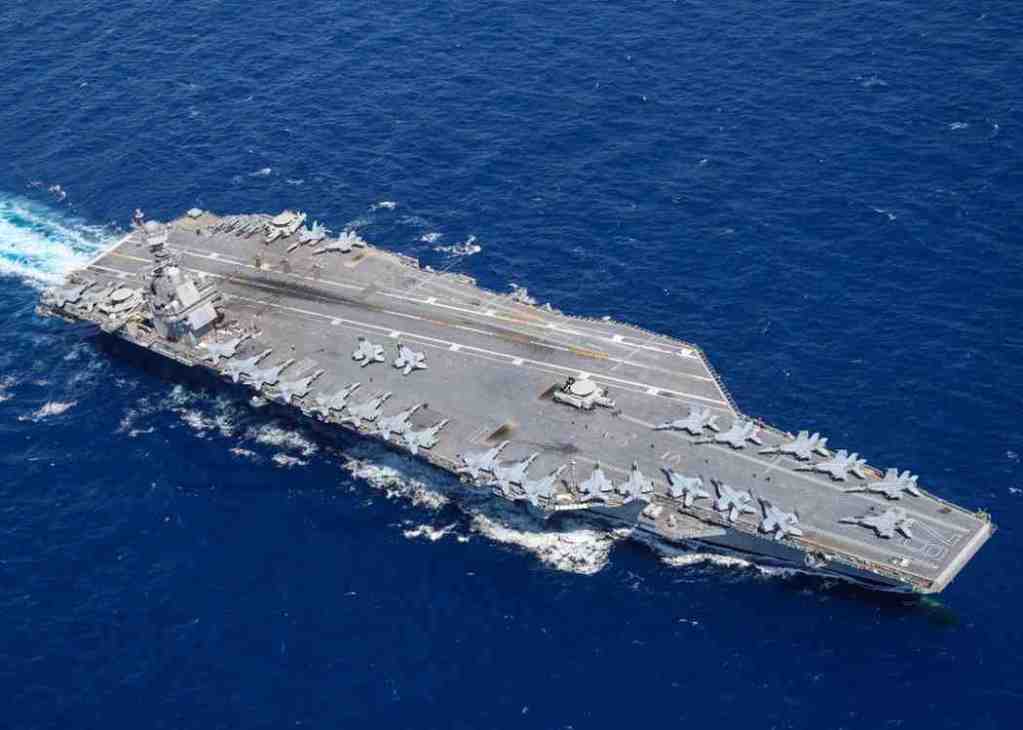
In the blue-water theater of global power projection, nothing says “superpower” like the silhouette of a 100,000-tonne nuclear-powered aircraft carrier. But as of late February 2026, the world’s most advanced warship, the USS Gerald R. Ford (CVN-78), is becoming a case study in a different kind of reality: the breaking point of human and mechanical endurance.
While the “Ford” was designed to be the pinnacle of naval engineering, its current deployment has turned into a marathon with no clear finish line. Originally slated to return to Norfolk, Virginia, in early March 2026, the carrier has seen its deployment extended twice. Now diverted from the Caribbean to the Middle East to join the USS Abraham Lincoln in a massive buildup against Iran, the Ford is pushing toward a record-breaking 300+ days at sea.
Queue longer than Wednesday Offer at KFC to Access Toilets:
One of the most publicized and unglamorous problems aboard the $13 billion supercarrier is its sewage system. Unlike the gravity-fed systems on older Nimitz-class ships, the Ford uses a vacuum-based sewage network adapted from commercial cruise ships to save weight and water.
However, “high-tech” has met “harsh reality.” The system’s narrow pipes have proven remarkably fragile. As of February 24, 2026, reports indicate that a single flush of a prohibited item (like a paper towel) can disable the toilets for an entire department.
- 45-Minute Queues: With over 4,600 personnel on board, sailors are reportedly waiting up to 45 minutes just to use the restroom.
- 19-Hour Shifts: Hull Technicians (the Navy’s plumbers) are working nearly around the clock to clear blockages.
- The “Acid Flush”: Deep cleaning the calcium buildup in these pipes requires a specialized acid flush that can typically only be done in a shipyard, leaving the crew to “patch and pray” while at sea.
The Toll on the Crew: Fatigue, Morale, and “Ghost Ships”
Behind the impressive flight deck operations where Electromagnetic Aircraft Launch System (EMALS) catapults fling jets into the sky, is a crew operating at the edge of psychological exhaustion.
A deployment extension is a “morale killer.” It breaks the unspoken contract between a sailor and their family. In the current 2026 mission, reports have surfaced of sailors missing the birth of children, funerals of patriarchs, and critical family milestones.
- The “300-Day” Shadow: If the Ford remains at sea through May, it will rival the longest deployments of the Vietnam War.
- Readiness vs. Reality: While the Navy insists the ship remains “operationally ready,” a fatigued crew is a dangerous crew. Studies on naval sleep deprivation show that sailors on extended deployments often average less than six hours of sleep, leading to a “safety climate” where near-misses on the flight deck become statistically inevitable.
The Limit of Naval Power: How Much Can You Push?
There is a theoretical limit to how long a carrier can stay at sea. Technically, a nuclear-powered ship like the Ford has “infinite” range; its reactors can run for 25 years without refueling. The limit is determined by three things:
- People: Mental health and “burnout” usually trigger a decline in performance after 7 months (210 days).
- Provisions: While food can be resupplied at sea via “UNREP” (Underway Replenishment), specialized spare parts for high-tech sensors often run dry.
- Maintenance: Every day at sea is a day of “deferred maintenance.” The Ford was scheduled for a critical dry-dock period in early 2026; every day it stays in the Middle East, that maintenance backlog grows, potentially shortening the overall life of the ship.
What can India Learn
India, currently operating the INS Vikramaditya and the indigenously built INS Vikrant, is watching the Ford’s struggle with keen interest. During the recent Operation Sindoor and the ongoing International Fleet Review (IFR-2026) in Visakhapatnam, the Indian Navy has showcased its own carrier battle groups.
However, India faces a similar “Rotation Reality.” If India wants to maintain a “persistent” presence in both the Arabian Sea and the Bay of Bengal, it technically needs three carriers:
- One Deployed: On active patrol.
- One Training: Preparing for the next cycle.
- One in Refit: Undergoing essential maintenance in the shipyard.
With only two carriers currently active, India runs the same risk as the US: “Burning out the fleet.” If a crisis forces a carrier like the Vikrant to stay at sea for 9 or 10 months, the subsequent maintenance period will be twice as long, leaving a massive gap in India’s maritime security. This is why the Indian Navy is aggressively pushing for a third carrier (IAC-2), to ensure that no Indian sailor ever has to face the “Ford-level” fatigue currently seen in the Atlantic.
The Human Element in a Machined World
The USS Gerald R. Ford is a marvel of the 21st century, but its second deployment extension is a reminder that the “most expensive ship in history” is still powered by human hearts and minds. As the Ford crosses the Mediterranean toward the Persian Gulf, its mission is a show of force to the world. But for the 4,600 sailors on board, the mission is simply to endure.
Whether it’s a vacuum toilet or a missed homecoming, the “Ford” saga proves that global power projection isn’t just about the number of jets on a deck it’s about the resilience of the people beneath it.
About the Author